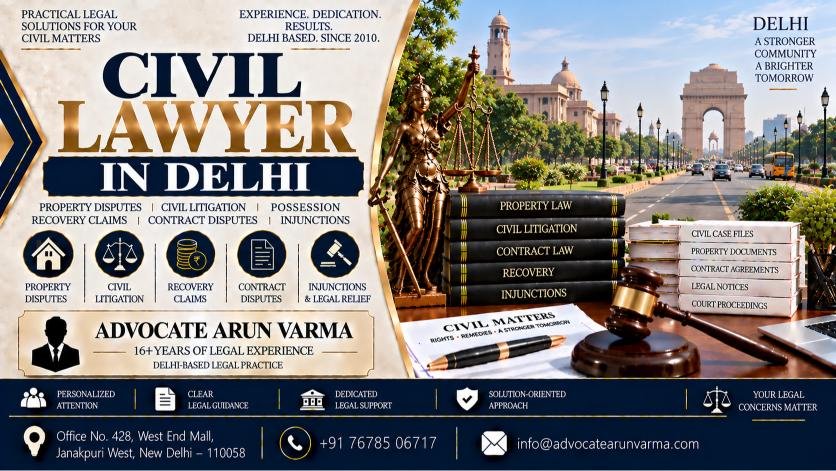
A Civil Lawyer in Delhi may assist individuals, families, property owners, landlords, tenants, businesses and other parties dealing with civil disputes and court-related legal matters. Advocate Arun Varma provides legal assistance concerning property disputes, possession, recovery claims, contractual disagreements, injunctions, declarations and civil litigation, subject to the facts, documents and procedural circumstances of each matter.
Civil disputes in Delhi can arise from property transactions, ownership and possession issues, unpaid dues, contractual obligations, tenancy arrangements, inheritance-related claims and other disagreements involving civil rights. The appropriate legal response depends on the nature of the dispute, the available evidence, previous proceedings and the applicable law.
A consultation concerning a civil matter may involve reviewing the relevant documents, understanding the factual background, identifying the current procedural position and considering what legal issues may require attention. Whether representation is undertaken should be confirmed directly with the advocate’s office.
Civil Lawyer in Delhi
Discuss the facts and documents relating to your civil matter and understand the procedural issues that may require attention.
When Civil Legal Assistance May Be Required in Delhi
Civil legal assistance may become relevant at different stages of a dispute. Some matters begin with a disagreement between parties, while others may already involve a legal notice, court proceeding or existing order.
- Property ownership or title disputes
- Possession and recovery of possession matters
- Property transaction disputes
- Landlord and tenant disputes
- Money recovery and unpaid dues
- Contractual disagreements
- Alleged breach of contract
- Injunction-related proceedings
- Declaration and specific-performance matters
- Inheritance and succession-related disputes
- Legal notices and replies
- Civil court notices and summons
- Pending civil litigation
- Interim applications and procedural matters
The appropriate legal response depends on the circumstances of the particular matter. Agreements, property records, notices, correspondence, payment records and previous court orders may need to be examined.
Civil Lawyer for Matters Across Delhi
Civil disputes may arise in different parts of Delhi and may involve different courts or forums depending on the nature of the case. The locality where a dispute arises is not, by itself, sufficient to determine the appropriate court or legal procedure.
Depending on the matter, legal assistance may involve:
- Reviewing the factual background and chronology
- Examining property and contractual documents
- Reviewing legal notices and correspondence
- Understanding the procedural position
- Preparing or reviewing legal documents
- Considering appropriate civil applications or proceedings
- Assisting with court proceedings where representation is undertaken
- Reviewing subsequent orders and procedural developments
The appropriate approach should be based on the actual dispute, documentary record and applicable law.
Property Disputes in Delhi
Property disputes can concern ownership, title, possession, boundaries, sale transactions, agreements, documentation or competing claims concerning property.
Depending on the circumstances, relevant records may include sale deeds, conveyance documents, agreements to sell, title documents, possession documents, payment records, correspondence and previous court orders.
A property dispute requires examination of the documentary and factual history. The availability of a particular civil remedy depends on the circumstances and applicable law.
Property Ownership and Title-Related Matters
Disputes concerning property ownership may involve competing title documents, succession claims, transactions, family arrangements, possession or other circumstances affecting the parties’ claimed interests.
Documents that may be relevant include:
- Sale deeds and conveyance documents
- Agreements and transaction documents
- Title-related records
- Possession documents
- Payment records
- Family settlement documents where applicable
- Legal notices
- Previous judgments and court orders
The legal position should be assessed from the complete documentary record rather than from a single document viewed in isolation.
Possession Disputes and Civil Claims
Possession-related disputes may arise between owners, purchasers, occupants, landlords, tenants or other parties claiming an interest in property.
The legal position may depend on the nature of possession, ownership records, contractual arrangements, documentary evidence and previous proceedings.
Where a possession dispute is already before a court, the pleadings and existing orders should be reviewed carefully before considering further action.
Property Transactions and Documentation
Disagreements can arise from property transactions because of payment issues, incomplete documentation, delayed performance, disputed terms or alleged failure to comply with an agreement.
Depending on the matter, relevant documents may include:
- Sale agreements
- Sale deeds
- Conveyance documents
- Payment receipts
- Bank transaction records
- Property correspondence
- Legal notices
- Previous agreements or settlement documents
A document review can help establish the chronology and identify the legal issues that require further consideration.
Money Recovery and Civil Claims in Delhi
Money recovery disputes may arise from unpaid invoices, loans, advances, business transactions, contractual obligations, services or other financial arrangements.
Relevant evidence may include contracts, invoices, payment records, bank statements, correspondence, acknowledgements and legal notices.
The appropriate legal process depends on the underlying transaction, nature of the claim, documentary evidence and applicable procedural requirements.
Contract Disputes and Breach of Contract
Contractual disputes may arise where one party alleges non-payment, non-performance, delayed performance, breach, wrongful termination or failure to comply with agreed obligations.
A review of the contractual record may include:
- The original agreement
- Amendments or supplementary agreements
- Invoices and payment records
- Email and other correspondence
- Notices exchanged between the parties
- Termination or cancellation communications
- Documents showing performance or non-performance
The wording of the actual agreement and the surrounding circumstances are important when assessing a contractual dispute.
Injunctions and Other Civil Relief
Some civil disputes involve applications for injunctions or other forms of civil relief. These issues may arise in property disputes, contractual disputes and other matters involving competing claims or alleged interference with civil rights.
Whether an injunction or another remedy is available depends on the facts, evidence, applicable law and procedural circumstances.
The existence of a dispute does not by itself establish that a particular remedy will be granted.
Declaration and Specific Performance Matters
Certain civil disputes involve questions concerning legal rights, contractual obligations or performance of an agreement. Depending on the circumstances, a party may consider whether declaratory relief, specific performance or another civil remedy is legally available.
Such matters can require examination of the underlying documents, contractual terms, limitation issues, conduct of the parties and applicable law.
Landlord and Tenant Disputes
Landlord and tenant disputes may concern rent, possession, termination, contractual obligations, security deposits, maintenance responsibilities or other issues arising from a tenancy.
Relevant documents may include rent agreements, lease documents, payment records, notices, correspondence and previous orders.
The applicable legal position depends on the nature of the tenancy, contractual terms and relevant statutory provisions.
Inheritance and Succession-Related Civil Matters
Property-related disputes can also arise following the death of a family member or in connection with inheritance, succession, partition or competing claims to property.
Depending on the circumstances, relevant documents may include wills, title documents, death certificates, family records, settlement documents and court orders.
Inheritance-related disputes should be examined on the basis of the actual family circumstances, documents and applicable law.
Legal Notices in Civil Disputes
A legal notice may communicate a demand, allege a breach, seek payment, raise a property claim or communicate a proposed legal course.
If a legal notice is received, the original document and related attachments and correspondence should be preserved where available.
The appropriate response depends on the allegations, supporting documents, chronology and procedural circumstances. A legal notice is not itself equivalent to a final court determination.
What to Do After Receiving a Civil Court Notice or Summons
A civil court notice or summons should be reviewed carefully. The recipient should note the court, case number, parties, nature of the proceeding and next listed date where applicable.
Practical preparation may include:
- Preserving the complete notice or summons
- Obtaining accompanying pleadings or applications where applicable
- Collecting relevant property or contractual documents
- Preserving payment records and correspondence
- Preparing a basic chronology of events
- Providing details of previous proceedings concerning the dispute
- Checking the applicable appearance or response requirements
Procedural deadlines can be important. The appropriate response should therefore be considered with reference to the actual court document and circumstances of the proceeding.
Civil Litigation and Court Proceedings in Delhi
Civil litigation can involve multiple procedural stages. Depending on the nature of the matter, these may include filing, service, appearance, pleadings, interim applications, evidence, arguments and orders or judgment.
The procedure can vary according to the nature of the dispute and the court or forum involved.
A civil litigation lawyer may assist with reviewing the case record, preparing appropriate documents and representing a party where representation is undertaken.
Existing court orders should be reviewed carefully before further action is taken.
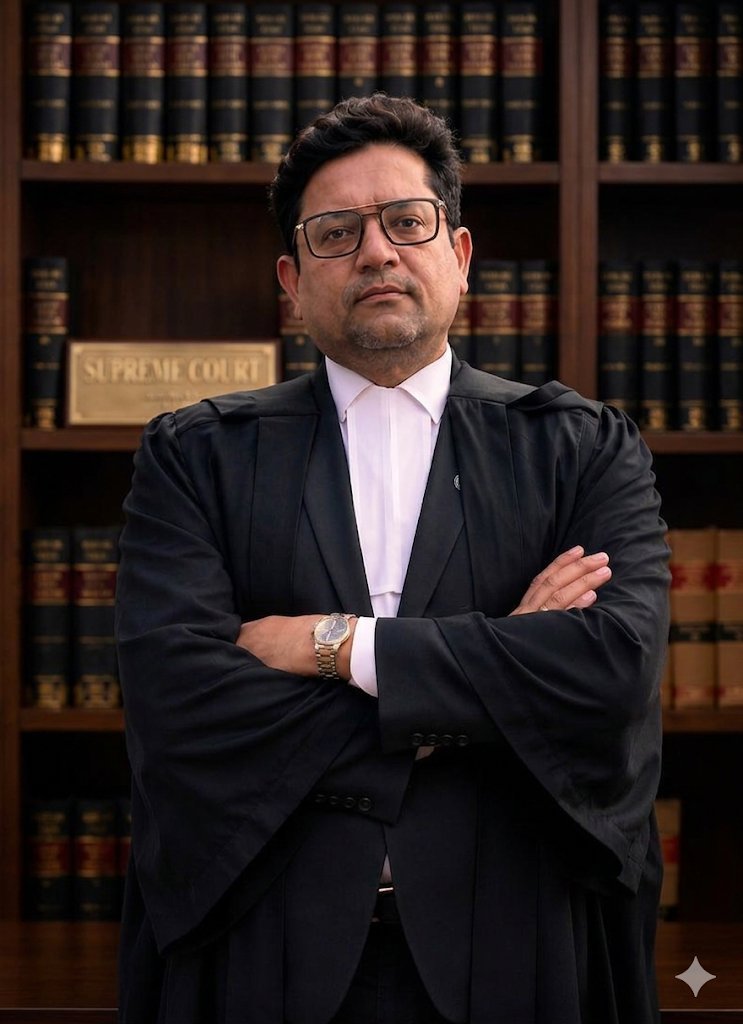
Arun Varma
Experienced Advocate in Delhi
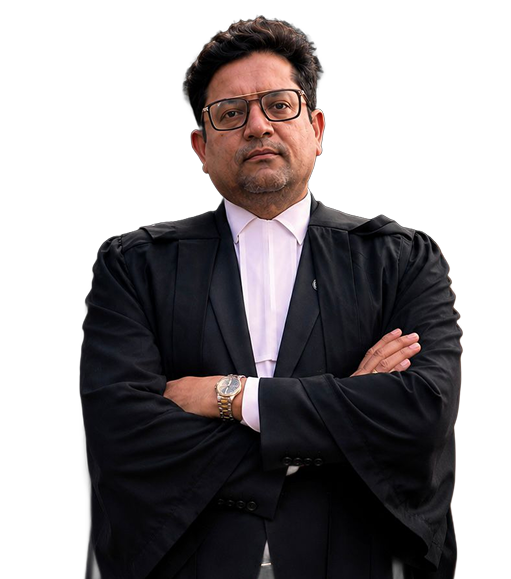
Advocate Arun Varma is an experienced legal professional based in Delhi, providing representation and legal assistance across a wide range of matters. His practice includes criminal defence, civil litigation, property disputes, family and matrimonial matters, documentation, and other legal issues. Known for his practical approach, strong courtroom representation, and commitment to protecting his clients\\\' interests, he handles every matter with professionalism and attention to detail.
Case-Specific Approach to Civil Litigation
There is no single legal approach that applies to every civil dispute. Matters that appear similar may involve different documents, contractual terms, limitation questions, factual circumstances or procedural histories.
A case-specific review may consider:
- The parties involved
- The chronology of events
- The documents supporting the respective positions
- The nature of the legal claim or defence
- Previous notices and correspondence
- Existing litigation
- Previous court orders
- The current stage of proceedings
- The relief being sought
Original documents should be preserved wherever possible. Relevant electronic records should also be retained and should not be altered or removed.
Documents to Prepare for a Civil Law Consultation
The documents required depend on the nature of the matter. Where available, it can be useful to organise the records chronologically before a consultation.
- Property title documents
- Sale deeds and conveyance documents
- Agreements and contracts
- Rent or lease documents
- Legal notices and replies
- Court notices and summons
- Pleadings and applications
- Court orders and judgments
- Payment records and invoices
- Bank or transaction records relevant to the dispute
- Email and other relevant correspondence
- Photographs or other documentary evidence
Organising the documents can make it easier to establish the chronology and identify the issues requiring further review.
Choosing a Civil Lawyer in Delhi
When considering a civil advocate, it can be useful to determine whether the advocate’s current practice covers the particular category of dispute and whether the advocate is available to undertake the matter.
Practical considerations may include:
- Experience with the relevant type of civil dispute
- Familiarity with civil litigation procedure
- Ability to review documentary evidence carefully
- Clarity regarding the scope of legal work
- Communication concerning procedural developments
- Understanding of the court or forum involved
Descriptions such as “best civil lawyer in Delhi” should not replace checking the advocate’s actual professional information, current practice and suitability for the particular matter.
About Advocate Arun Varma
Advocate Arun Varma is a Delhi-based advocate practising since 2010. His legal practice includes assistance in civil and property-related matters, subject to the nature of the matter and current practice.
For a civil dispute connected with Delhi, the office can review the basic facts and available documents and indicate whether the matter falls within the advocate’s current practice and whether representation can be undertaken.
Every civil matter depends on its own facts, documents, procedural history and applicable law. No particular outcome should be assumed before the matter has been reviewed.
Civil Lawyer in Delhi
Discuss your property, litigation, recovery, possession or contract matter based on the facts and documents of your particular case.
Practical Preparation for a Civil Law Consultation
Before a consultation, it can be helpful to prepare a short chronology explaining what happened, when it happened and what has occurred since the dispute began.
Documents should ideally be arranged by date, with original documents kept separately from copies. If proceedings are already pending, the case number, court details, latest order and next date should be available.
The factual position should be presented accurately, including circumstances that may not appear favourable to one party. A proper legal assessment depends on the complete factual and documentary record.
Practical Considerations for Civil Matters in Delhi
Delhi has multiple courts and forums dealing with different categories of civil proceedings. The appropriate forum depends on the nature of the dispute, jurisdictional requirements and applicable procedural law.
A matter associated with a particular locality should therefore not automatically be assumed to belong before a particular court solely because of the locality’s name.
If proceedings are already pending, the latest order and relevant case documents should be available for review. If proceedings have not yet started, the available documents and factual chronology can help identify the issues that may require attention.
Contact Advocate Arun Varma
For a civil matter connected with Delhi, you may contact Advocate Arun Varma’s office to discuss the nature of the dispute and the documents available.
Advocate Arun Varma
Office No. 428, West End Mall,
Janakpuri West, New Delhi – 110058
Phone: +91 76785 06717
Email: info@advocatearunvarma.com
Whether a matter can be accepted and whether representation can be undertaken depends on the circumstances, documents, current practice and availability of the advocate.
Civil Lawyer in Delhi
Discuss the circumstances and documents relating to your civil matter with Advocate Arun Varma's office.
Conclusion
Civil disputes in Delhi can involve property, possession, contracts, recovery claims, injunctions, tenancy, inheritance and other civil issues. The appropriate legal response depends on the facts, documents, procedural position and applicable law.
A careful review of the available records can help identify the nature of the dispute and the procedural issues requiring attention. Advocate Arun Varma provides legal assistance in civil and property-related matters, subject to the facts of the matter and whether the matter falls within the advocate’s current practice.
Frequently Asked Questions About Civil Lawyer in Delhi
Who is the best Civil Lawyer in Delhi?
There is no objective basis for declaring one civil lawyer to be the best for every matter. The appropriate advocate depends on the nature of the dispute, relevant experience, procedural requirements, documents and whether the advocate currently undertakes that type of matter.
What does a Civil Lawyer in Delhi do?
A civil lawyer may assist with property disputes, possession, recovery claims, contracts, injunctions, declarations, tenancy disputes, inheritance-related matters and civil litigation, depending on the facts and the advocate’s current practice.
Can a civil lawyer help with a property dispute in Delhi?
A civil lawyer may assist with property disputes involving ownership, possession, contractual issues, property documents or other civil claims. The available legal options depend on the documents, facts, previous proceedings and applicable law.
Can a Civil Lawyer in Delhi assist with a possession dispute?
A civil lawyer may assist with possession-related disputes involving owners, occupants, purchasers, landlords, tenants or other parties. The legal position depends on the documentary record, nature of possession, contractual arrangements and applicable law.
Can a Civil Lawyer in Delhi help with a money recovery claim?
A civil lawyer may assist with money recovery disputes involving unpaid dues, contractual obligations, invoices, loans or other financial transactions. The appropriate procedure depends on the underlying transaction and available evidence.
Can a civil lawyer assist with a contract dispute?
Yes, a civil lawyer may assist with disputes involving alleged breach of contract, non-payment, non-performance, termination or other contractual disagreements. The actual agreement and related correspondence should generally be reviewed before assessing the dispute.
What should I do after receiving a civil court notice or summons?
Keep the complete notice or summons and accompanying documents, note the court and case details, check the listed date and arrange for the documents to be reviewed. The appropriate response depends on the actual contents of the court document and procedural stage.
Can a Civil Lawyer in Delhi help with an injunction matter?
A civil lawyer may assist with an injunction-related proceeding where the facts and applicable law support consideration of such relief. Whether an injunction is available depends on the circumstances and evidence of the particular matter.
Can I find a Civil Lawyer near me in Delhi?
Legal assistance may be available from advocates practising in Delhi. Physical proximity is only one consideration; the nature of the dispute, relevant practice area and availability of the advocate should also be considered.
Why is it important to preserve civil case documents?
Documents can be important for establishing the chronology, contractual terms, property history, payments, communications and procedural history of a dispute. Original documents and relevant electronic records should be preserved and not altered or removed.
Can a Civil Lawyer in Delhi represent me before the appropriate court?
Representation may be undertaken where the matter falls within the advocate’s current practice and the relevant procedural and professional requirements are satisfied. The appropriate court or forum depends on the nature and circumstances of the case.
Who is Advocate Arun Varma for civil matters in Delhi?
Advocate Arun Varma is a Delhi-based advocate practising since 2010. He provides legal assistance in civil and property-related matters, subject to the facts of the matter, current practice and availability.
What documents should I bring for a civil law consultation?
Depending on the matter, useful documents may include property records, agreements, contracts, legal notices, court notices, pleadings, previous orders, payment records, correspondence and other documents relevant to the dispute.